Research topics
Axis 1: Clinical decision system based on heterogeneous health data
 Axis 1 provides a framework for integrating new statistical methodologies within a clinical decision support system (CDSS) grounded in heterogeneous health data sources: Electronic Health Records (EHR), national databases (SNDS, HDH), IoT medical devices, and multi-omics data. Raw health data present some specific challenges such as a large data size, complexity of the relational schema, heterogeneity, numerous levels for categorical variables, missing data never at random and time-dependence. A preparatory step is necessary to make data exploitable for statistical analysis, a step that requires deep medical expertise.
More specifically for Datavers, clinical targets include patient health trajectory analysis such as rehospitalisation prediction and disease progression modelling in geriatrics, diabetology, and paediatric oncology and precision medicine, including patient stratification, biomarker selection, and adverse drug event prevention.
Axis 2: Space-time dependent data analysis
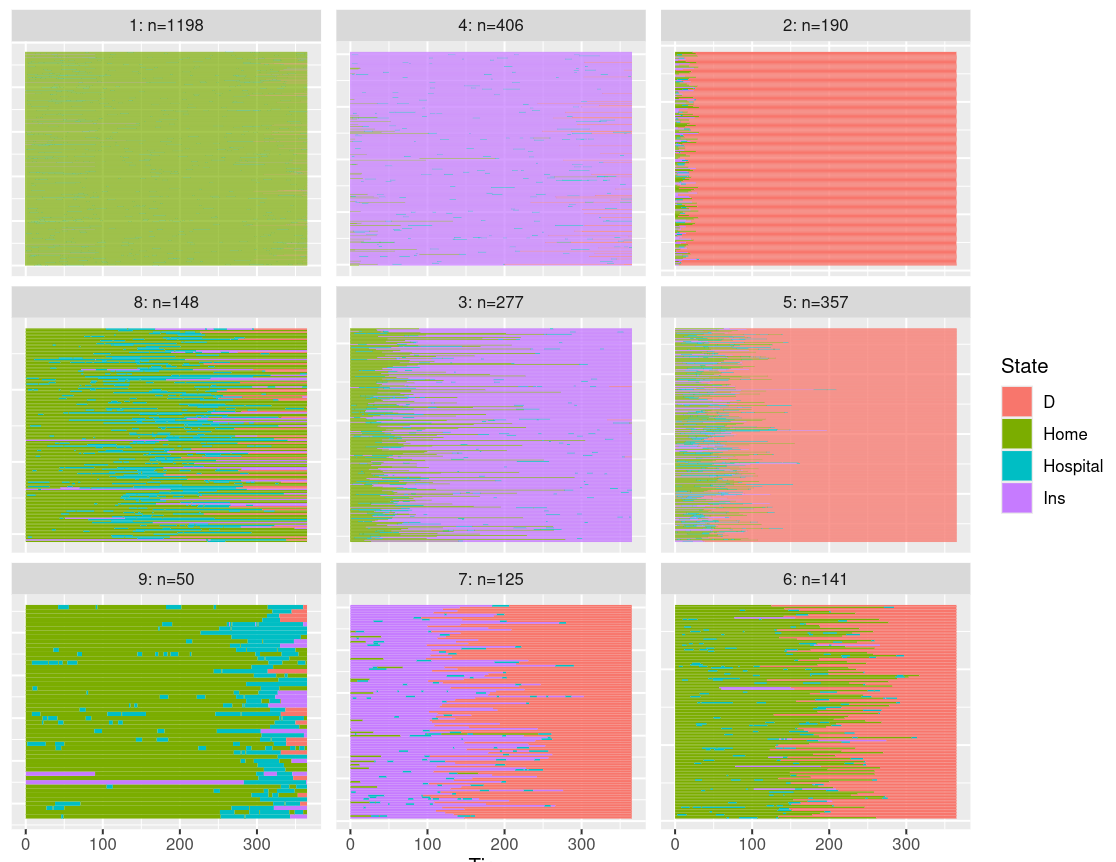
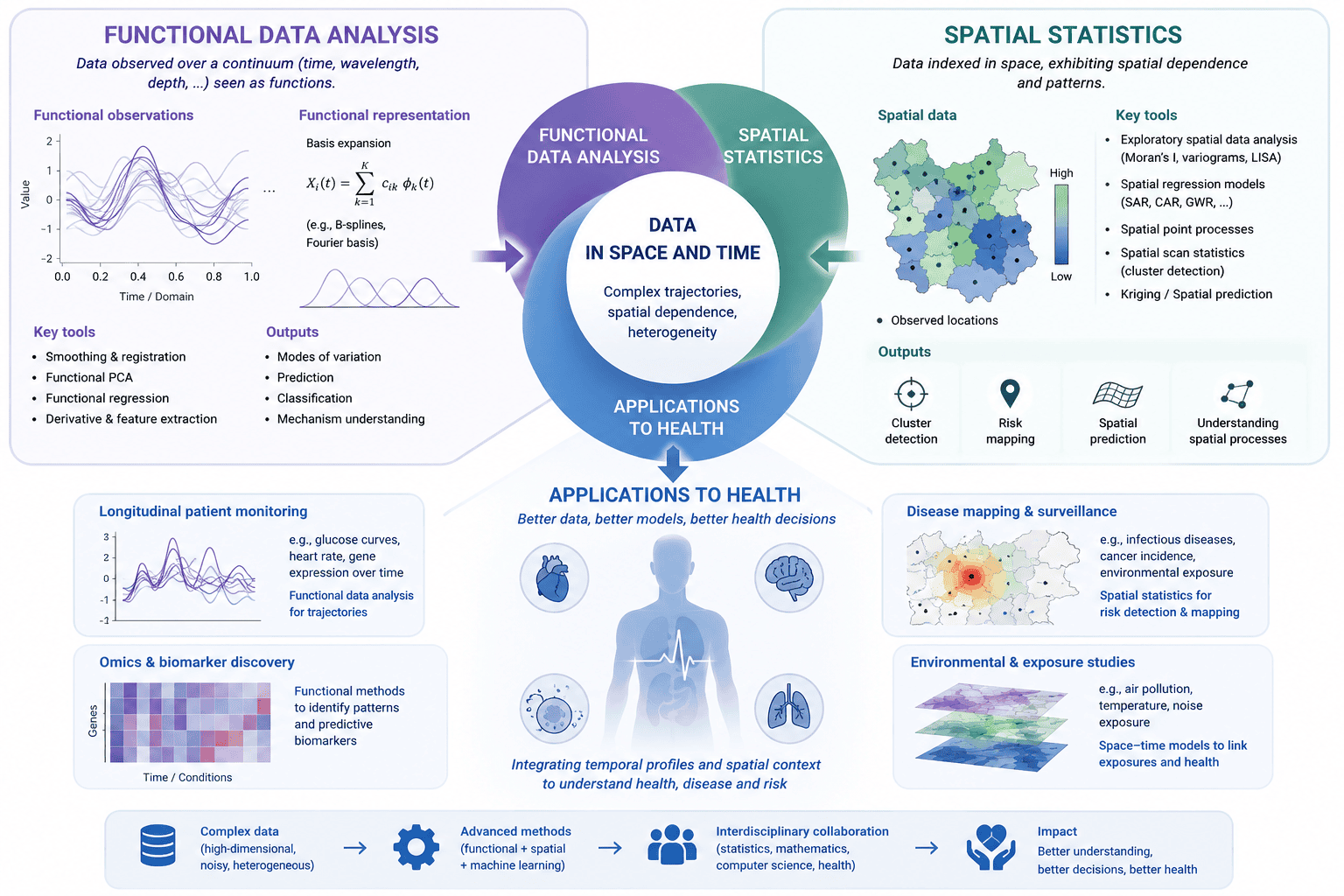 Data collected in Axis 1 are time and space dependent, requiring dedicated statistical frameworks. Axis 2 develops methods within Functional Data Analysis and spatial statistics to address three complementary challenges.
Categorical functional data. Patient pathways and other status-evolving processes are modelled as samples of jump stochastic processes with continuous time. For instance, the patient's path during hospitalisation (emergency, intensive care, internal medicine, and discharge) constitute a categorical functional trajectory. The objectives are: estimation of transition rates between states, dimension reduction and visualisation of categorical trajectories (implemented in the cfda R package ), and clustering and supervised learning from latent representations of these trajectories.
Spatial functional data. When observations are distributed over irregular spatial domains, modelling must account for spatial dependency, anisotropy, and non-stationarity. We adopt a semi-parametric regression framework with partial differential equation regularisation.
Multivariate functional correlation analysis. We study the correlation structure between two sets of spatially dependent functional variables. Extending canonical correlation analysis to this spatially dependent setting is an open methodological problem with direct applications in environmental epidemiology.
Axis 3: Complex, high-dimensional and tall data analysis
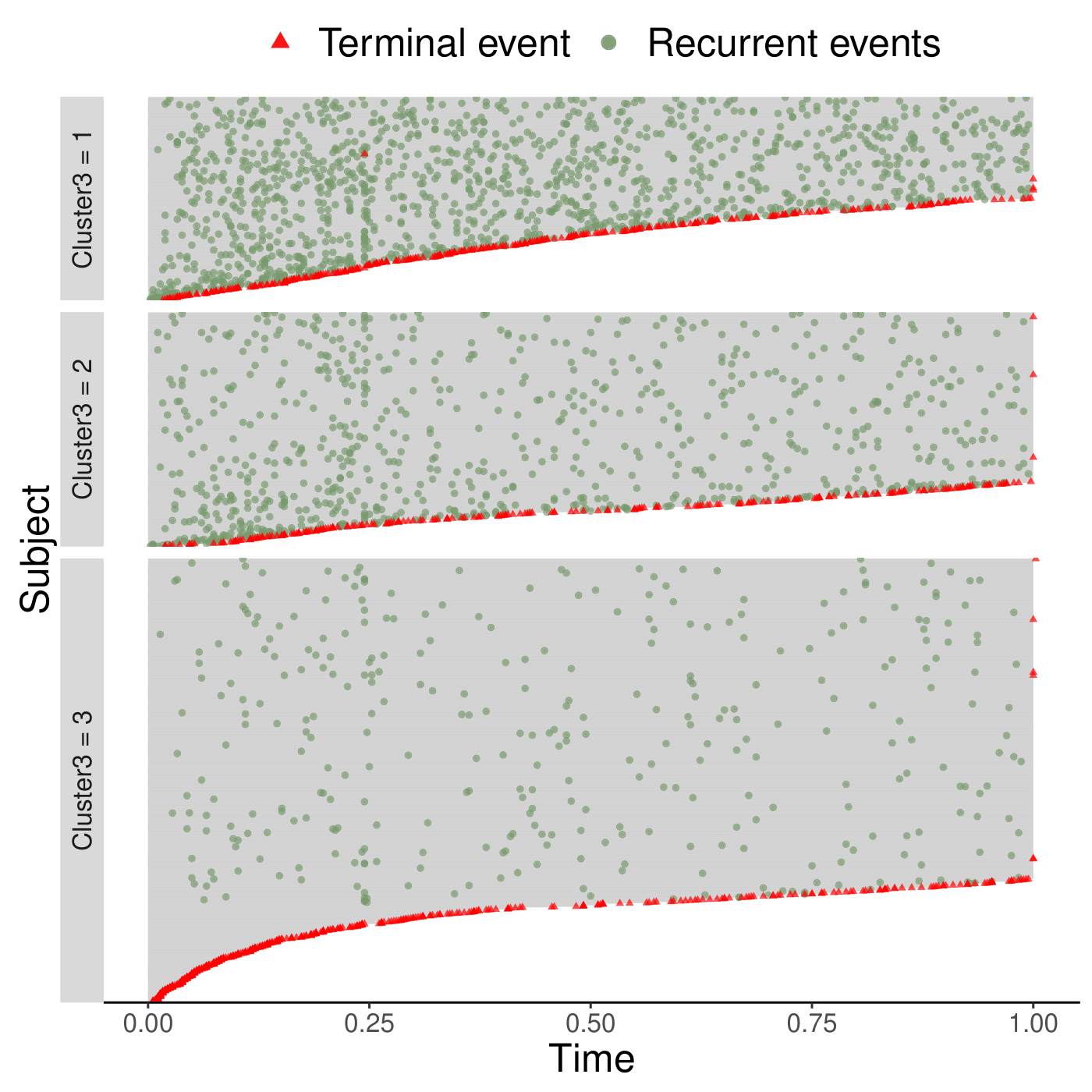 Axis 3 addresses the statistical challenges arising from tall data and high-dimensional data along three directions.
Clustering of tall and heterogeneous data. As national databases reach large amount of records, detecting small but clinically meaningful patient subgroups becomes both essential and computationally demanding. We develop frugal clustering approaches based on bin-marginal approximations, which preserve the detectability of rare clusters without relying on subsampling. A parallel challenge concerns the selection of the clustering method itself: in the absence of ground truth, choosing between mixture models, spectral methods, and variational autoencoders (VAE) requires a principled model selection framework that we are working to unify across these a priori irreconcilable paradigms (implemented in the Rmixmod package ).
Feature selection with censored data. High-dimensional omics data combined with censored time-to-event outcomes and competing risks pose a joint estimation problem that existing methods address only partially. A concrete case is the joint analysis of transcriptomic or proteomic profiles with survival data in the presence of competing causes of death. We extend penalised regression approaches (implemented in the MLGL R package ) to simultaneously handle high dimension, competing risks, and prior biological information.
Joint modelling of longitudinal high-dimensional and censored data. When both explanatory variables and outcomes are measured repeatedly over time, and the endpoint is itself censored, the statistical problem requires modelling the joint dynamics of longitudinal high-dimensional biomarkers and survival data. We investigate regularised latent class models and, at longer term, ODE-based systems and Kalman filter frameworks extended to multivariate survival settings.
Collaborations
Compagnies
- Cerema
- Décathlon
- Horiba
- Seckiot
- Withings
Local
- Laboratoire Paul Painlevé (UMR CNRS 8524, Université de Lille)
- METRICS (ULR 2694, Université de Lille et CHU Lille)
- CHU Lille
- ONCOLille
- Pasteur / IBL (plateforme Bilille)
- Inocs (ANR GoToLess, Inria)
- Scool (CDP Numetab, Inria)
- Fun (Cerema, Inria)
National
- Celeste (frugal clustering, Inria Saclay)
- SISTM (Inria Bordeaux)
- Premedical (Inria)
- Statify (Inria, Grenoble)
- University Bourgogne
- University Compiègne
- University Clermont
- University Nice
- University Lyon 1 & 2
- Inrae Dijon
- ENSAI Rennes
- INSERM (Sepia, Rennes)
International
- Medical School Boston, Massachusetts, USA
- UC Davis, California, USA
- University of Melbourne, Australia
- Université Libre de Bruxelles, Belgium
- University of Granada, Spain
- University College Dublin, Ireland
- VU Amsterdam, Netherlands
- University of Catania, Italia